
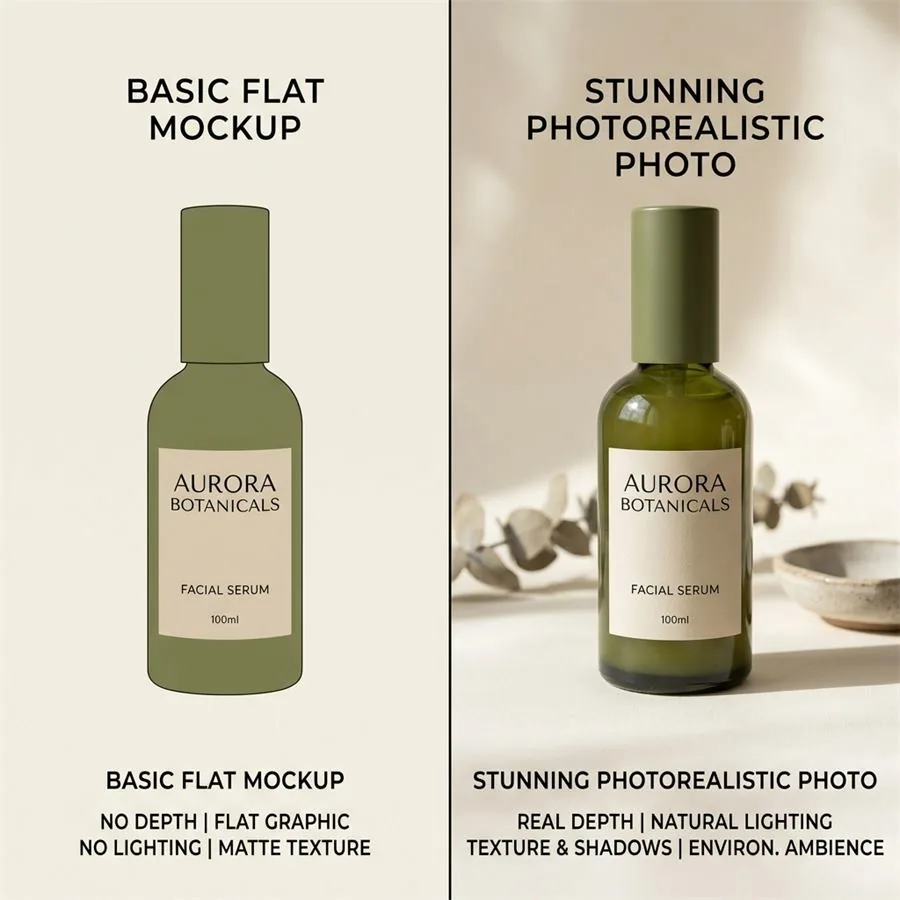
Many e-commerce sellers starting out use Canva's mockup templates to create product images. It's free, it's fast, and it requires zero design skill. But as brands grow, the limitations of template mockups become apparent — and the question inevitably arises: is there a better option?
AI product photography represents the next level up from template mockups. This guide compares both approaches across quality, cost, flexibility, and conversion performance to help you decide which is right for your brand's current stage.
AI product photography
Want a practical recommendation for your product?
Share the product, sales channel, deliverables, and timing. Pixelense will recommend the clearest scope without changing the published starting rates.
What Are Canva Mockups?
Canva mockups are pre-designed templates where you insert your product image or design into a pre-existing scene. A t-shirt mockup shows your design on a pre-photographed model. A mug mockup shows your artwork on a standard mug in a standard setting. The template is fixed — you only change what appears on the product.
Advantages: Free or low-cost, instant results, no technical skill required, good for print-on-demand items where the product shape is standard.
Limitations: Everyone uses the same templates (your competitor's mug sits on the same desk). No customisation of lighting, angle, or environment. The product doesn't look "real" — experienced buyers recognise mockups instantly. Limited to product categories where templates exist.
What Is AI Product Photography?
AI product photography generates entirely new, unique images based on your actual product. Rather than inserting a design into a pre-existing template, the AI creates a bespoke scene — unique lighting, unique environment, unique composition — tailored to your product and brand aesthetic.
The result is imagery that looks genuinely photographed, not templated. Each image is unique to your brand.
Quality Comparison
Canva mockups: Quality is limited by the template. Lighting is fixed, composition is fixed, and the product insertion often shows visible edges or colour mismatches. For simple products like t-shirts or mugs, mockups are adequate. For anything with complex geometry, texture, or reflective surfaces, they fall short.
AI photography: Quality approaches or matches professional studio photography. The AI generates unique lighting, realistic shadows, and material-accurate rendering for each product. Glass reflects light naturally. Fabric shows realistic drape. Metal has proper specular highlights. The result is imagery buyers trust.
Uniqueness and Brand Differentiation
This is the most significant difference. Canva's mockup library is used by millions of sellers. If you're selling a custom mug on Etsy, your listing image sits on the same wooden desk, with the same lighting, as hundreds of other sellers. There is zero visual differentiation.
AI photography creates imagery that belongs exclusively to your brand. Your product in a unique setting, with unique lighting, in a composition designed to match your brand's specific aesthetic. In crowded marketplaces, this visual uniqueness directly affects click-through rates.
Cost Comparison
- Canva Free: $0 — access to limited mockup templates
- Canva Pro: $13/month — expanded template library
- AI Photography (Pixelense): Custom-quoted per project — bespoke, brand-matched imagery (request a free quote)
Canva is cheaper in absolute terms. The useful question is whether a template mockup communicates the real product and brand as clearly as a custom, reference-led image. Compare both approaches with controlled tests instead of assuming a fixed conversion gap.
Conversion Performance
This is where the practical difference matters most. Research consistently shows that custom, professional-quality product photography outperforms template mockups on:
- Click-through rate from search results: Unique images stand out in marketplace grids
- Time spent on listing: Professional imagery holds attention longer
- Add-to-cart rate: Buyers trust products that look professionally presented
- Return rate: Accurate product representation reduces "not what I expected" returns
For sellers at the early stage with minimal budget, Canva mockups are a reasonable starting point. But the moment your brand reaches a stage where conversion rate optimisation matters — typically when you're spending on advertising — upgrading to AI photography delivers measurable ROI.
When to Use Each
Use Canva mockups if:
- You're validating a product idea and need quick visuals to test market demand
- Your product is a standard-format print-on-demand item (t-shirt, mug, phone case)
- You have zero budget for imagery and need something immediately
Use AI photography if:
- You're ready to invest in conversion-optimised imagery that drives revenue
- Your product has unique physical properties that mockups can't capture
- You want visual differentiation from competitors using the same templates
- You're scaling ad spend and need images that maximise ROAS
Ready to upgrade from mockups to custom AI photography? Start a project with Pixelense and see the quality difference for yourself.
AI product photography
Request a project-fit review for your next image set.
Share the product, sales channel, deliverables, and timing. Pixelense will recommend the clearest scope without changing the published starting rates.