
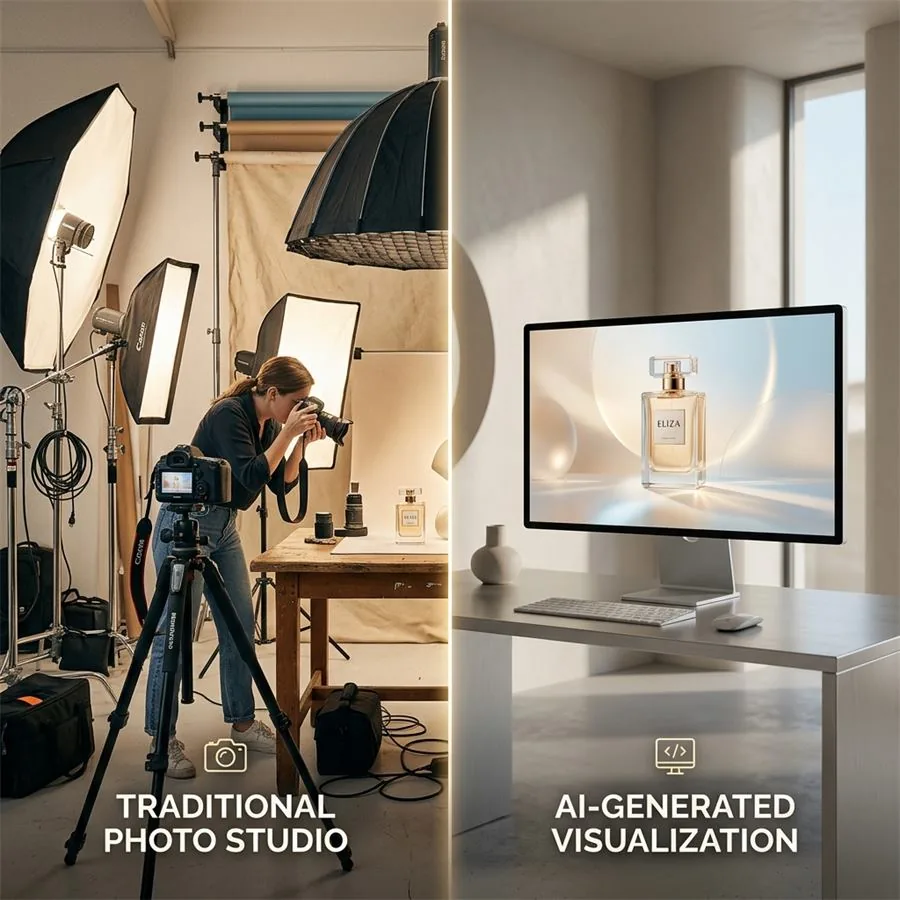
Quick answer: use professional photography when the image must prove exact color, fit, texture, scale, or physical performance. Use AI-assisted product images when you need controlled lifestyle scenes, campaign variations, and faster channel adaptation. Many ecommerce brands get the strongest result from a hybrid workflow: verified product photography for evidence, then AI-assisted production for range.
AI product images vs. professional photography is a production decision, not simply a technology choice. The right route depends on what the image must prove, how accurately the physical product must be represented, how many channel variations are needed, and how quickly the brand needs approved assets.
If you're an e-commerce brand weighing your options — whether you're launching a new Shopify store, scaling your Amazon catalogue, or refreshing your brand's visual identity — this guide provides a detailed, honest comparison of AI product photography versus traditional studio photography across every dimension that matters: cost, speed, quality, scalability, and creative flexibility. Use the AI product photography ROI calculator alongside this guide to model your own catalogue and refresh cycle.
AI product photography
Want a practical recommendation for your product?
Share the product, sales channel, deliverables, and timing. Pixelense will recommend the clearest scope without changing the published starting rates.
The Cost Factor: Compare the Same Deliverables
Cost is useful only when both quotes cover the same products, image jobs, accuracy requirements, review rounds, retouching standard, usage, and channel exports.
Traditional Studio Photography Costs
- Capture: photographer, crew, equipment, studio, location, and shoot time
- Physical production: product shipping, styling, props, set construction, and talent where needed
- Finishing: selection, retouching, colour correction, compositing, and exports
- Internal time: brief preparation, attendance, feedback, approvals, and reshoots
AI Product Photography Costs
- Project scope: Pixelense prices around deliverables, creative complexity, reference preparation, and finishing rather than a universal per-image rate
- Reference preparation: approved product photography, label artwork, dimensions, materials, and non-negotiable details
- Production: art direction, generation or compositing, selection, and correction
- Finishing: retouching, product-accuracy review, approvals, and channel exports
- Quote basis: request the same shot list, revision allowance, retouching standard, and usage needs
AI-assisted production can reduce some direct and coordination costs, especially when a project would otherwise require multiple physical sets or locations. The saving is project-specific, and human briefing, selection, retouching, approvals, and quality control remain part of the work.
Speed to Market: Measure Your Actual Workflow
A physical shoot adds scheduling, product handling, capture, and retouching. An AI-assisted project adds reference preparation, direction, generation, correction, and approval. Record days from approved input to approved delivery for both routes instead of assuming a universal timeline.
Traditional Studio Timeline
- Confirm the shot list, usage, crew, location, styling, and capture plan
- Book production and move products or samples where required
- Capture, select, retouch, review, revise, and export
AI Photography Timeline
- Confirm reference quality, label artwork, product truth, and shot plan
- Approve a direction before the full set expands
- Generate or composite, correct, review, revise, and export
Pixelense delivered Ciana's complete Amazon listing image set in under 48 hours, but that is a verified fact for one project rather than a universal promise. Future timing depends on the product, references, deliverable count, and review requirements. Read the documented case study.
Image Quality: Has AI Closed the Gap?
The useful answer is conditional. AI-assisted work can be convincing for many secondary ecommerce and campaign scenes, but verified photography remains stronger when the image must prove exact colour, material, fit, construction, contents, or regulated details.
Where AI excels:
- Secondary scene exploration: Controlled backgrounds and lighting directions around an approved product reference
- Lifestyle and contextual scenes: Placing products in realistic environments — kitchen counters, bathroom shelves, office desks — without building physical sets
- Repeatable catalogue direction: Reuse a defined composition, lighting, and review checklist across SKUs
- Controlled variation: Explore different environments while keeping the approved product treatment stable
Where traditional studios still have an edge:
- Ultra-precise colour matching: For luxury goods where a 2% colour deviation is unacceptable, calibrated studio photography with controlled lighting still offers marginally better accuracy
- Complex mechanical products: Items with intricate moving parts, unusual geometries, or internal mechanisms can still challenge AI systems
- Physical model photography: Real people wearing or using products provide verified fit, interaction, movement, and endorsement context that synthetic scenes should not imply
For many standard consumer products, AI can add useful lifestyle, campaign, and advertising variations when the source references are strong. The key differentiator is the team directing, reviewing, and retouching the work, plus the willingness to use real photography when the customer needs exact evidence. Visit our work to see how Pixelense labels and directs its visual studies.
Scalability: From 10 Products to 10,000
Scalability is where AI photography creates the most decisive advantage. Traditional studio photography scales linearly — every additional product requires additional studio time, photographer hours, and editing costs. The cost per image stays constant or increases as shoots get more complex.
AI photography can reuse an established visual direction across a larger catalogue, reducing repeated setup work. Additional images still require references, generation, selection, retouching, approval, and export, so marginal cost does not disappear. The benefit is a more repeatable production system.
For a large home-goods catalogue, compare batch size, reference preparation, review capacity, correction rate, and final exports. A repeatable direction can reduce setup duplication, but each SKU still needs a product-truth check.
Creative Flexibility: Testing and Iteration
One of AI photography's most underappreciated advantages is the ability to test and iterate at minimal cost. In a traditional studio, every additional concept — a different background, a different lighting mood, a different composition — costs more time and money. This creates a natural pressure to "get it right the first time" and limits creative experimentation.
AI-assisted production can make controlled visual variants easier to produce. If you test them, keep the audience, offer, placement, and measurement window as consistent as possible, then treat the result as evidence for that product rather than a universal conversion promise.
Authenticity, Rights, and Platform Rules
Neither route removes the need for rights and policy review. Traditional shoots need model, location, prop, and usage permissions. AI-assisted work needs tool-license review, accurate product representation, appropriate disclosure or metadata where a platform requires it, and a check that synthetic people or scenes do not imply a real endorsement.
Marketplace rules are channel-specific and change over time. Keep a verified main product image when a platform or category expects documentary accuracy, then reserve synthetic or composited scenes for placements where they are allowed and useful. Legal counsel should review high-risk claims, regulated products, and rights questions.
Which Should You Choose?
Choose AI product photography if:
- You need a repeatable route for secondary scenes and channel variants
- You manage a large catalogue and need visual consistency at scale
- Your budget is tight and traditional studio costs are prohibitive
- You sell on Shopify, Amazon, or marketplaces where standard product photography formats are required
- You want to A/B test multiple visual styles without multiplying your costs
- You're a dropshipper or print-on-demand seller without physical stock to photograph
Choose traditional studio photography if:
- You need human models interacting physically with your product
- You're producing a luxury campaign where tactile realism is paramount
- Your product has complex internal mechanics or unusual physical properties that require in-person photography
- You need certified colour accuracy for contractual or regulatory purposes
For most ecommerce brands in 2026, the strongest answer is not all-AI or all-studio. Keep verified photography wherever customers need exact evidence, then use AI-assisted production for controlled scene changes, campaign concepts, seasonal variations, and channel-specific crops. That hybrid approach improves speed without asking synthetic imagery to prove something it cannot verify.
If the right route is still unclear, send Pixelense the product and intended channel. The project recommendation will separate the images that need verified photography from the variations suited to AI-assisted production.
Related Decision Paths Before You Choose
The right production model depends on what the image must prove. Use these next pages to turn the comparison into a practical brief:
- Need proof of quality? Review Pixelense portfolio transformations and compare input references to final campaign outputs.
- Need a repeatable operating system? Use the AI photography workflow guide and visual consistency guide.
- Need marketplace-ready files? Compare Shopify, Amazon, Etsy, and Google Shopping image needs.
- Need to improve source inputs? Start with phone product reference photography before ordering AI production.
- Need a realistic budget? Review the AI product photography cost and pricing guide.
- Running a smaller brand? Use the AI product photography for small businesses guide to compare costs, reference requirements, and when a real shoot is still the safer choice.
- Need a smaller first step? See affordable AI product photography options or try a free sample.
Frequently Asked Questions
Is AI product photography as good as traditional studio photography?
AI product photography can be effective for lifestyle scenes, campaign concepts, and channel variations. Traditional photography remains stronger when exact product evidence, calibrated color, fit, texture, movement, or documentary authenticity is required. The right choice depends on the image's job.
How much does AI product photography cost compared to a traditional studio?
Traditional studio photography commonly adds shoot-day fees, crew, location, styling, shipping, and per-image editing. AI-assisted projects still require direction, selection, retouching, and approval. Pixelense scopes work by the deliverables and creative complexity, so compare written quotes against the same shot list and usage needs.
How fast can AI product photography be delivered?
Pixelense's typical first-delivery window is 24 to 72 hours for a focused scope. Larger campaigns, complex product references, and revision rounds take longer. Traditional studio timing also varies with crew, location, product shipping, and post-production.
AI product photography
Request a project-fit review for your next image set.
Share the product, sales channel, deliverables, and timing. Pixelense will recommend the clearest scope without changing the published starting rates.