
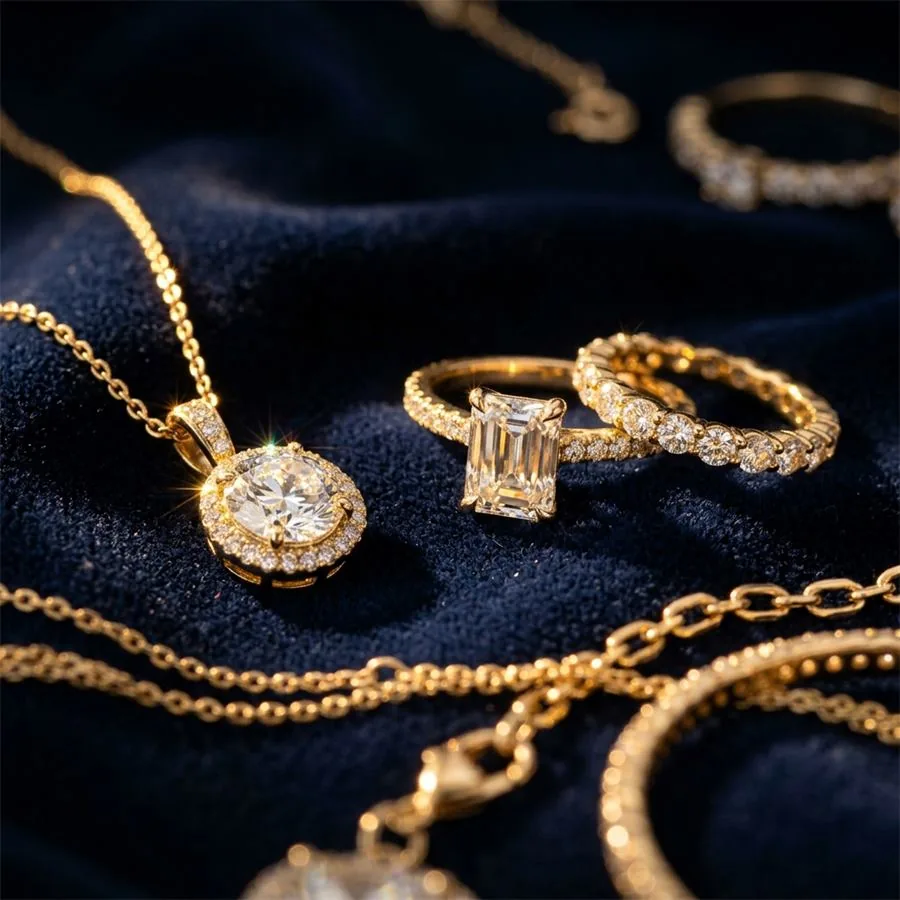
Jewelry and cosmetics are arguably the most technically demanding product categories in commercial photography. Both require an almost surgical level of detail — gemstone facets that need to sparkle credibly, lipstick finishes that must convey exactly the right texture, foundation shades that need to match real skin tones. Both involve surfaces that reflect light unpredictably: glass bottles, metallic casings, polished stones, glossy packaging. And both are categories where customers make purchasing decisions based almost entirely on visual impression, often from a thumbnail.
Getting jewelry and cosmetics photography right is difficult. Getting it wrong is expensive — in returns, in customer complaints, in the erosion of brand trust that comes when a product arrives looking nothing like its listing image. This guide explains how AI photography handles the specific technical challenges of these categories, and what brands need to know to get the most from an AI photography workflow.
Beauty product photography
Want a practical recommendation for your product?
Share the product, sales channel, deliverables, and timing. Pixelense will recommend the clearest scope without changing the published starting rates.
Why Jewelry and Cosmetics Are the Hardest Products to Photograph
Traditional photographers working in these categories spend years developing specific technical skills because the challenges are genuinely difficult:
- Reflective surfaces: Metal, glass, and glossy finishes pick up reflections of everything in the shooting environment — lights, cameras, the photographer, the ceiling. Managing these reflections requires tent lighting, polarising filters, and careful positioning that takes time and expertise to get right.
- Small scale: Rings, earrings, and lipstick bullets are tiny objects. Capturing the level of detail that communicates quality requires macro lenses, precise depth-of-field control, and often focus stacking — compositing multiple shots taken at different focal distances to achieve sharpness across the entire product.
- Colour accuracy: A ruby red lipstick that photographs as burgundy, or a yellow gold ring that photographs as rose gold, creates customer expectation failures that generate returns and reviews. Colour fidelity in cosmetics photography is especially critical because purchasing decisions are colour-driven.
- Gemstone and crystal behaviour: Diamonds, sapphires, and other precious stones refract light in ways that are notoriously difficult to capture. The goal is not just accuracy but brilliance — images that convey the stone's fire and life in a two-dimensional photograph.
How AI Photography Handles Jewelry: Metal Types and Gemstones
AI photography approaches jewelry with different techniques depending on the specific materials involved. Understanding these distinctions helps brands brief their AI photography partner more effectively.
Yellow gold and rose gold: Warm metals photograph best against neutral or dark backgrounds that don't compete with the metal's warmth. AI photography uses controlled highlight direction to reveal the three-dimensionality of gold surfaces — the difference between a flat yellow plane and a piece of jewellery with depth and weight. For polished gold, this means tight specular highlights. For brushed or hammered gold, it means directional raking light that reveals the surface texture.
White gold, platinum, and silver: Cool metals require a different approach. The risk with silver and platinum is over-brightening to the point where the metal loses its identity — instead of looking like precious metal, it looks like grey plastic. AI photography maintains tonal gradation in white metals to preserve their inherent brilliance without losing detail in the highlights.
Diamonds and clear gemstones: The goal is to capture fire — the coloured light dispersed through the facets — as well as brilliance (white light return) and scintillation (the sparkle when the stone or light moves). AI photography for diamonds uses multiple light source positions to reproduce this three-dimensional optical behaviour in a static image. The result is a diamond that looks alive on screen, not a glassy, flat shape.
Coloured gemstones: Rubies, sapphires, emeralds, and other coloured stones require accurate colour reproduction above all else. AI photography calibrates colour output to reference images, ensuring that a 2.5-carat Burma ruby appears in its true pigeon's-blood red rather than a digitally shifted approximation.
Cosmetics Photography: Finishes, Swatches, and Skin Tones
Cosmetics photography divides into two core requirements: product photography (the item itself, in its packaging) and application photography (the product as it appears on skin). Both are critical for conversion in beauty e-commerce.
Product photography for cosmetics packaging: Makeup packaging is almost always reflective — lipstick tubes, foundation bottles, eyeshadow palettes with glossy lids. The challenge is capturing the packaging's design clearly while managing reflections. AI photography uses compositing approaches to ensure packaging text, logos, and design details are legible while the overall image maintains the premium feel the brand projects.
Texture and finish communication: Whether a foundation is dewy or matte, whether an eyeshadow is metallic or glitter-packed, whether a lip gloss has a jelly or glass finish — these distinctions determine purchase decisions. AI photography can generate swatch-on-skin images, close-up texture macro shots, and finish-specific lighting setups that communicate product texture more accurately than generic product shots.
Skin-tone-matched lifestyle shots: One of the most significant advances in AI cosmetics photography is the ability to generate lifestyle images across multiple skin tones from a single product reference. A foundation range with 40 shades ideally has imagery showing application across the full skin tone spectrum — something that requires multiple models and multiple shoots in traditional photography. AI can produce these variations from a single briefing, representing a substantial cost and time saving for cosmetics brands with extensive shade ranges.
Shot Types: Flat Lay vs. Hero Shot vs. Model Shot
For jewelry and cosmetics, different shot types serve different purposes in the customer journey, and a complete image set should include all three:
- Flat lay: Products arranged on a flat surface, photographed from directly above. Works particularly well for cosmetics collections, gift sets, and multi-piece jewelry sets. Allows multiple items to be shown in a single image and creates a strong, graphic visual that performs well on Instagram and Pinterest. AI photography excels at styled flat lays, allowing surface textures, props, and compositions to be refined with precision.
- Hero shot: A single product, photographed with full studio attention, usually on a neutral or styled surface. The hero shot is the main listing image — the one that has to work in a thumbnail and at full size simultaneously. For jewelry, this is typically a 45-degree angle that reveals the three-dimensionality of the piece. For cosmetics, it's usually a three-quarter angle that shows the packaging design and any texture or finish visible on the product.
- Model shot (or worn shot): Jewelry shown on a hand, wrist, ear, or neck. Cosmetics shown applied to skin. These images answer the customer's fundamental question: "What will this look like on me?" For jewelry in particular, a worn shot on the right skin tone can dramatically improve conversion rate compared to a product-only listing.
Matching Brand Colour Palettes in AI Photography
Brand colour palette consistency is especially important in jewelry and cosmetics, where the visual identity of the brand is inseparable from the product. A cosmetics brand built around dusty rose and antique gold needs every image to reinforce those colours — in the backgrounds used, in the props selected, in the overall tone of the image.
At Pixelense, we work from your existing brand identity documents or from a colour brief you provide. We apply consistent background colours, surface textures, and ambient colour grades across your full image set so that every product in your range looks like it belongs to the same visual world. This consistency is especially critical for brands selling across multiple platforms — the same visual identity should be immediately recognisable whether a customer encounters the brand on their website, on Instagram, or on Amazon.
For jewelry and cosmetics brands looking to scale their image production without sacrificing the visual precision these categories demand, AI photography represents the most practical and cost-effective solution available today. Browse our portfolio to see examples of our jewelry and cosmetics work, or explore our services to understand what's included in each package.
Ready to see what your products look like with the detail they deserve? Start a project with Pixelense and receive your first images within 24–48 hours.
Beauty product photography
Request a project-fit review for your next image set.
Share the product, sales channel, deliverables, and timing. Pixelense will recommend the clearest scope without changing the published starting rates.