
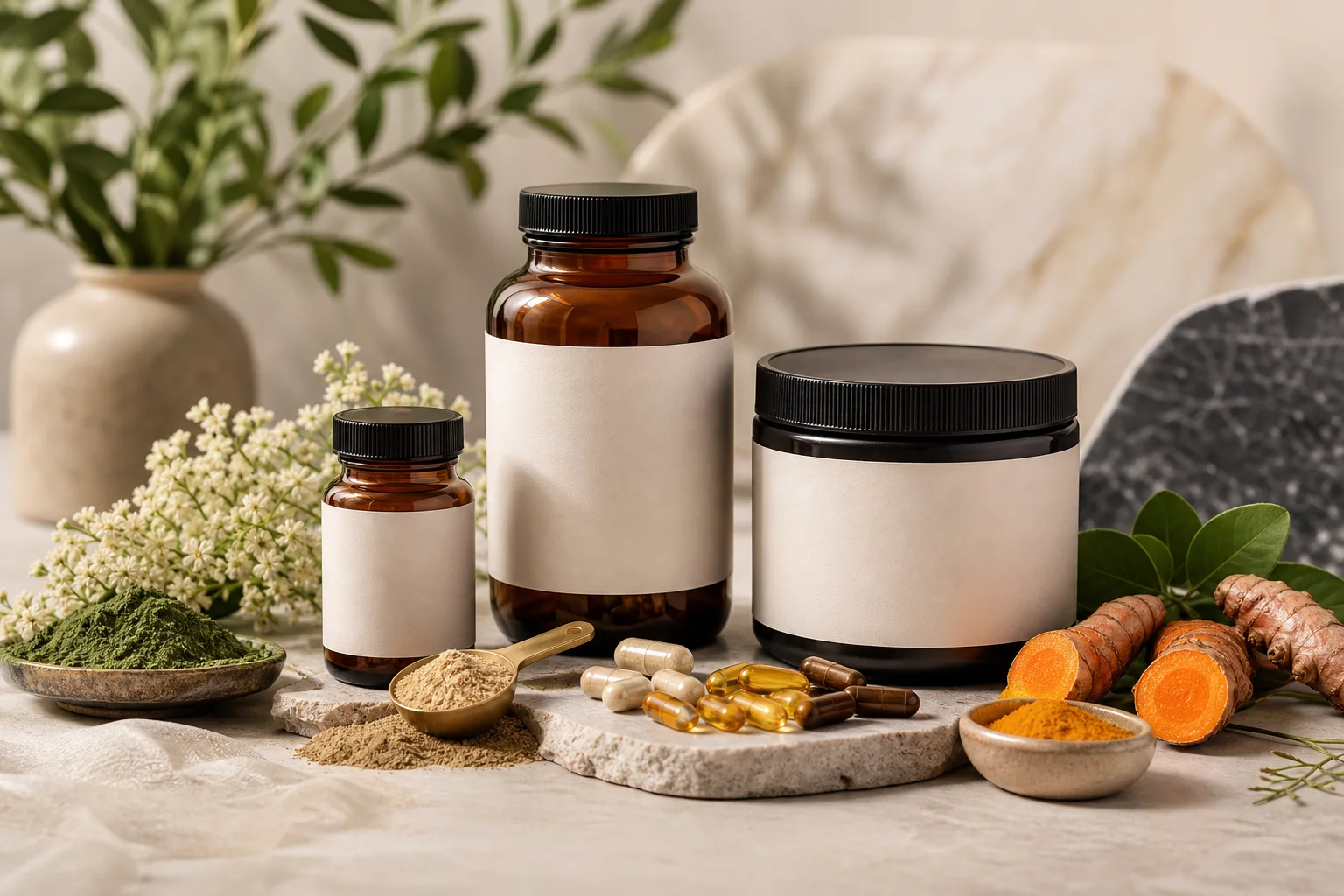
Quick answer: a strong supplement product photography stack needs eight distinct jobs covered: a compliant main image, alternate angle, packaging detail, dosage-form close-up, ingredient story, lifestyle scene, benefit-led frame, and bundle or range image. Start with accurate label artwork and verified product references before creating any lifestyle variation.
Most supplement brands still rely on a beige bottle, a generic stock photo of pills, or a recycled botanical flat-lay. That sameness creates an opportunity for brands willing to build a credible image system around the actual product, packaging, ingredients, and buyer questions.
AI product photography is well-suited to supplements specifically because the category demands two seemingly contradictory cues: clinical credibility (the buyer wants a pharmacy-grade product) and warm ingredient storytelling (the buyer wants natural sourcing and tradition). A great supplement brand balances both. AI lets you produce both at the volume the category needs without running two separate photo shoots a year.
Supplement product photography
Want a practical recommendation for your product?
Share the product, sales channel, deliverables, and timing. Pixelense will recommend the clearest scope without changing the published starting rates.
Why Supplement Photography Lags the Category's Sophistication
The reason most supplement imagery is mediocre isn't lack of ambition. It's structural:
- Label artwork changes. Reformulations, approved-claim updates, and seasonal variants can make an older image library inaccurate. A compositing workflow can update supplied artwork without rebuilding every environment.
- SKU counts multiply the review work. Every additional bottle, tub, or pouch adds reference checks, label versions, dosage-form details, crops, and channel exports.
- Marketplace rules are specific. Amazon’s current guidance says the main image should accurately represent the product, use a pure white background, and fill at least 85% of the frame. Category guidance can add further requirements, so sellers should check the current rule before upload. Review Amazon’s product image guidance.
- Health-related claims need brand approval. The image team can flag obvious problems, but the brand remains responsible for regulatory, medical, dosage, certification, and marketplace claims.
AI-assisted production can help when the bottle reference is reliable and the final image is reviewed by a person. Label updates become controlled compositing tasks, marketplace main images are planned as a separate deliverable, and campaign environments can change without asking a model to invent product facts.
The Supplement Imagery Stack
A complete supplement imagery library for a single SKU includes:
- Amazon main image — pure white background, product centred, 85% frame fill, no text overlay. Full Amazon spec guide here.
- Brand hero shot — same bottle, brand-aligned backdrop and lighting. Used on the website PDP, email, and organic social.
- Ingredient flat-lay — bottle surrounded by hero botanicals (ashwagandha root, turmeric, mushroom slices, citrus, omega oils). Converts the ingredient-driven buyer.
- Pill or powder reveal — capsules cascading, powder scoop, gummy pattern. Closes the "is this real product?" curiosity gap.
- Lifestyle scene — bottle on a kitchen counter, on a workout mat, beside a smoothie. Anchors the product in a use moment.
- Family grouping — multiple bottles from the line shown together. Lifts AOV and signals product range.
- Detail macro on label — supplement facts panel close-up. Converts the compliance-aware, label-reading buyer.
- Routine sequence — multi-step daily routine visualised. Used in Amazon A+ Content and email funnels.
| Frame | Main job | Source-control check |
|---|---|---|
| 1. Main image | Marketplace search and product detail page | Exact product, pack quantity, clean edges, current category rule |
| 2. Alternate angle | Shape and packaging understanding | Bottle geometry, cap, closure, and scale |
| 3. Packaging detail | Readable product information | Supplied label artwork; no generated claims |
| 4. Dosage form | Show capsule, gummy, tablet, or powder | Actual colour, size, finish, and quantity cues |
| 5. Ingredient story | Explain approved ingredients visually | Only brand-approved ingredients and associations |
| 6. Lifestyle scene | Place the product in a believable routine | No medical outcome or unsupported use implied |
| 7. Benefit frame | Support approved product-page education | Brand-supplied copy and legal review where needed |
| 8. Bundle or range | Clarify variants and pack contents | Correct SKU, label version, colour, and quantity |
The Pixelense Supplement Workflow
1. Bottle reference + label artwork
Send phone references of the bottle (the empty form is fine — three angles) plus your print-ready label PDF or PNG. We use the bottle as the AI anchor and composite the supplied artwork in post-production, then review the final asset against the approved source.
2. Capsule, powder, or gummy reference
A macro of your actual capsule/tablet/gummy — colour, shape, gel-cap vs hard-tablet finish, embossed letters if any. We anchor the spill/pour shots to this reference so the product in your imagery matches what arrives in the customer's hand.
3. Ingredient styling brief
Which botanicals, fruits, or sources should appear in the flat-lay? Ashwagandha root, fresh turmeric, lion's mane mushroom, omega-3 fish, magnesium-rich greens, etc. Ground the imagery in the product's approved ingredient story instead of using generic wellness props that could imply the wrong formula.
4. Two-mood generation
Most supplement brands need both clinical and warm imagery. Clinical mood: clean white, soft cool light, lab-aesthetic surfaces (frosted glass, brushed steel). Warm mood: linen surfaces, soft daylight, botanical accents. We produce both moods per SKU so brand teams have ad creative for both audience segments.
5. Final QA and compliance flagging
We review every final image against the brand's compliance flags (no implied disease-prevention claims, no medical-context staging like pill-with-thermometer that could read as drug, etc.). Imagery is your responsibility legally, but we flag obvious risk so it doesn't surprise you in launch.
Two Production Patterns We Use Repeatedly
Pattern 1: "Ingredient hero" PDP layout. Use a sequence — bottle, ingredient flat-lay, dosage-form macro, lifestyle, and routine — when the product page needs to explain the product beyond the main image. The carousel becomes a structured education layer; any performance effect should be measured by the brand rather than assumed.
Pattern 2: Seasonal refresh without a new bottle treatment. Keep the approved bottle and label treatment stable while changing only the environmental styling: autumn warmth, fresh January greens, or a summer kitchen. This preserves product identity across a campaign refresh.
Cost Pattern: Supplement Brand With 25 SKUs
A 25-SKU supplement brand planning eight base images per SKU would need 200 files before seasonal refreshes and ad creative. Use that deliverable count to request comparable production quotes; the actual budget will depend on set complexity, styling, retouching, revision needs, and how much verified photography is required.
The operational value is consistency: a new SKU can enter the same visual system as an established one, provided the team supplies and approves the correct product references, label artwork, and dosage-form details.
First-hand marketplace production example
Pixelense delivered Ciana's complete Amazon listing image set in under 48 hours, covering product, pack-of-two, lifestyle, interior, detail, and feature-focused frames. Ciana is not a supplement brand, so this is evidence of the marketplace gallery workflow—not a supplement performance claim or a universal timing promise.
See the verified Ciana project and review the Amazon service.
If you are ready to brief this as a service rather than research the category, start with our dedicated Supplement product photography services for supplement brands page. It summarizes the deliverables, workflow, and image types for bottles, powders, gummies, capsules, and ingredient-led product pages.
Turn the strategy into a production-ready shot list
Separate essential ecommerce evidence from campaign variations before production begins. The free editable planner covers clean product heroes, packaging details, ingredient frames, lifestyle scenes, bundles, marketplace crops, and ad variants.
Download the wellness product shot list or review the label-accuracy workflow.
Frequently Asked Questions
Are AI product images compliant with Amazon's supplement listing rules?
They may be usable when the final asset follows the current category and marketplace requirements, accurately represents the exact product, and preserves any required metadata. Verify the latest Amazon policy for your marketplace and category before publishing.
Can AI render label text accurately for compliance purposes?
We do not rely on AI to generate label text. Supplied print-ready artwork is composited in post-production and reviewed against the source. The brand remains responsible for approving claims and regulatory content before publication.
How do you handle bottle shape variations — capsule vs powder vs gummy?
Each format has its own visual cues. Capsule and tablet bottles are easiest. Powder tubs need fill-line believability. Gummy jars need accurate gummy shape reference. Liquid tinctures need amber-glass dropper handling. We adapt per format.
Can you show pills, capsules, or powder spilled artistically?
Yes. These frames can help a shopper understand the dosage form and texture. We anchor each capsule, tablet, gummy, or powder treatment to a real reference so the size, colour, and finish match the actual product.
Supplement product photography
Request a project-fit review for your next image set.
Share the product, sales channel, deliverables, and timing. Pixelense will recommend the clearest scope without changing the published starting rates.